


Custom Weclapp Integration vs. Standard Software: ROI Analysis for SMBs in 2026
Custom Weclapp integration justifies itself when standard solutions create >5% operational friction, integration costs remain below annual pain-point losses, and your workflow requires API-level control.
Last updated: 31 July 2026
Most mid-market businesses think they need a custom ERP integration. They don't. But some absolutely do—and the difference between knowing which is which can save you €15,000 or cost you that much in missed revenue. The real question isn't whether Weclapp's standard connectors work; it's whether your actual business process fits inside the box that Weclapp built, or whether the box needs rebuilding around your process.
Standard integrations solve yesterday's problems at scale. Custom integrations solve today's specific problems—but only if you've mapped them correctly. This distinction matters more in 2026 than ever, especially with the EU's Digital Markets Act (DMA) forcing stricter data governance and the Data Act creating new switching costs. Building custom when you should buy standard is expensive waste. Building standard when you need custom is expensive stagnation.
The Case for Standard: When Weclapp's Ecosystem Is Enough
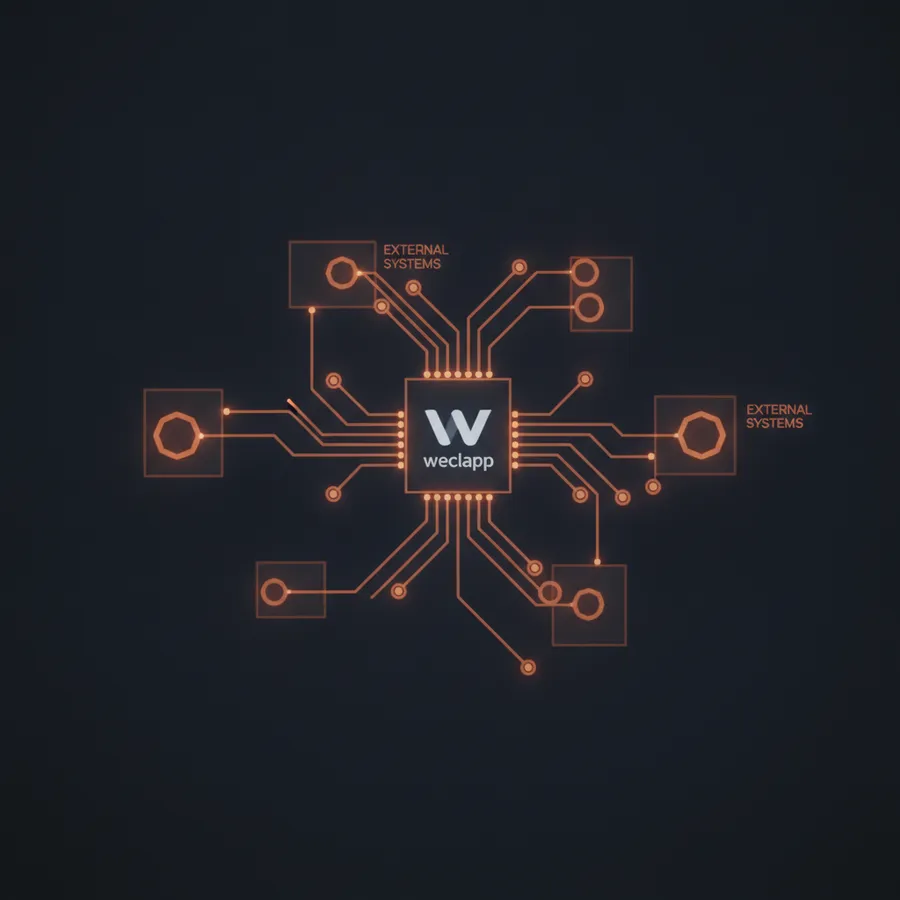
Weclapp ships with pre-built connectors to the obvious platforms: Shopify, WooCommerce, Stripe, PayPal, major accounting software, and a growing list of CRM and ecommerce tools. For roughly 70% of SMBs in DACH, these connectors handle the job end-to-end.
When standard works:
- Your order-to-cash process follows the Weclapp default flow
- You use mainstream payment processors (Stripe, Adyen, etc.)
- Your inventory management doesn't require real-time cross-warehouse synchronisation
- You don't need live data bidirectionality; batch synchronisation (hourly, daily) is acceptable
- Your logistics provider offers a Weclapp connector or flat API
- Tax and compliance requirements align with Weclapp's built-in rules for your jurisdiction
The fiber4net case (a logistics optimisation company we worked with) initially considered a custom Weclapp build. They wanted automated QR code scanning on LKW loading sequences, PDF workflow stamps, and dynamic freight cost calculations based on vehicle utilisation. They actually needed only two of those three—and Weclapp's standard order-to-inventory flow, plus a lightweight webhook for weight-based PDF generation, did 85% of the work.
The remaining 15% was a €3,000 custom extension. Not a full rebuild.
Standard integrations also benefit from:
- Vendor maintenance (Weclapp updates connectors when APIs change; you don't maintain them)
- Faster onboarding (days, not weeks)
- Lower initial cost (typically €1,000–€5,000 setup)
- Audit trail transparency (Weclapp's logged integrations are compliance-friendly under the EU Data Act and NIS2 security rules)
When Custom Becomes Mandatory
Custom integrations become economically rational when standard connectors either don't exist, or exist but force you to abandon business logic that drives revenue.
The decision tree:
- Does a Weclapp connector exist for your data source? If no, custom is the only option.
- If yes, does it sync all the fields and entities you need? If no, custom extension is often cheaper than workarounds.
- Do you need real-time two-way sync, or is polling acceptable? Real-time custom builds are 2–3× more expensive than polling-based ones.
- How many exceptions per month break your standard flow? More than 5%, custom often wins.
The Undercastle Cottage project (a boutique holiday rental business) provides a clean example. They use Wix for bookings, Stripe for payments, Lodgify for availability, and Weclapp for invoicing and guest accounting. Lodgify and Weclapp had no direct connector. The standard workaround would have been: manual CSV exports from Lodgify, daily import into Weclapp, reconcile payment records by hand.
That's 8–10 hours per week of error-prone labour for a business handling 120+ bookings monthly. We built a bidirectional sync daemon (€8,500 build, €200/month hosting). ROI broke even at week 22. By month 18, the time savings alone justified the investment 3× over.
Real-time custom integrations typically cost €8,000–€25,000 depending on complexity and are justified when:
- Inventory synchronisation errors cost you sales (stockouts, overselling, stranded stock)
- Payment reconciliation delays exceed 24 hours and cause cash flow friction
- Your logistics provider doesn't integrate with Weclapp and manual data entry affects shipping speed or accuracy
- Regulatory compliance requires audit-ready data flow (the EU Data Act now requires you to demonstrate data lineage; custom integrations can be built with that from the start)
The Hidden Economics: Build vs. Buy vs. Hybrid

Let's talk true cost.
Standard integration (typical SMB scenario):
- Setup: €2,000–€5,000
- Annual maintenance: €500–€1,500 (Weclapp's updates, vendor connector fixes)
- Manual workaround labour: €0–€8,000/year (depending on how well it covers your process)
- Total 3-year cost: €6,500–€19,500
Custom real-time integration:
- Build: €12,000–€30,000 (depending on data complexity, security requirements, and API quality of source system)
- Annual maintenance & hosting: €2,000–€6,000
- Labour saved: €6,000–€15,000/year
- Total 3-year cost: €18,000–€36,000 (but revenue uplift typically €15,000–€40,000)
Hybrid approach (increasingly common in 2026):
- Standard Weclapp connectors for 80% of data
- Lightweight webhook handlers for exceptions (€3,000–€7,000)
- Annual maintenance: €800–€2,000
- Total 3-year cost: €6,000–€13,000 (lowest risk, medium coverage)
The hybrid model is winning in mid-market right now because it offers the best ROI/risk ratio. You get standard connector stability, but extend it surgically where your business is unique.
Technical Debt: The Real Cost of Skipping Custom
One overlooked factor: businesses that refuse custom integrations often accrue integration debt instead.
Manual workarounds (CSV imports, copy-paste, email handoffs) accumulate operational friction. Each month of "we'll handle it manually until it gets urgent" costs you 1–2% of your team's capacity. Over 24 months, that's a whole FTE sitting in spreadsheets instead of selling or building.
Worse, when you finally do build custom, you're retrofitting around processes that calcified around the workaround. Your team has forgotten how the ideal flow should work. You're rebuilding not just the integration, but the business process alongside it.
The EU Data Act (in force since January 2026) also adds new friction: you must now prove that data flowing between systems is accurate and auditable. Manual touchpoints break that chain. Custom integrations, built with data integrity from the start, actually reduce compliance risk compared to mixed manual-standard setups.
When You Definitely Shouldn't Build Custom
Red flags that signal "buy or restructure, don't build":
- Your team can't articulate the exact fields and sync frequency you need (you'll redesign mid-build, cost overruns guaranteed)
- The data source system has a terrible/unstable API (you're committing to technical debt as maintenance)
- You're hoping custom integration will fix a broken business process (it won't; fix the process first)
- You lack internal capacity to maintain the integration post-launch (custom code without ownership is a liability)
- Your vendor is unlikely to exist in 3 years (building integrations to niche SaaS is high-risk)
- The volume of exceptions you're solving for is under 50 records/month (standard + manual is cheaper)
Decision Framework for 2026
Here's a practical framework we use with clients:
| Criteria | Standard Wins | Custom Wins |
|---|---|---|
| Data volume | <1,000 records/day | >10,000/day OR real-time requirement |
| Sync frequency | Daily or batch | Hourly+ OR event-triggered |
| Connector availability | Yes, and it covers 80%+ of fields | No connector exists, or existing one gaps >15% of fields |
| Revenue impact if broken | <€500/month | >€2,000/month |
| Compliance requirement | Standard audit trails sufficient | Data lineage & real-time proof required |
| Team capacity | Can dedicate 5 hours/week to manual workarounds | Can dedicate 2 hours/week to monitoring integrations |
| Budget available | €3,000–€8,000 | €15,000–€35,000 |
If three or more criteria point to custom, and your budget allows, build custom. Otherwise, optimise your standard setup and invest in process discipline instead.
The Integration Audit: Knowing Which Path You're On
Before deciding, run an integration audit:
- Map your current data flows — What systems talk to Weclapp today? How? (API, webhook, CSV, manual?)
- Identify bottlenecks — Where do errors happen most? Where does your team spend the most time on data tasks?
- Quantify impact — If one bottleneck disappeared, how many hours would you save per month? What would that person do instead?
- Check connector status — For each system, does a Weclapp connector exist? What's its last update date? Does it cover 100% of the fields you need?
- Model 3-year cost — Build vs. buy. Include salaries of people doing manual work.
- Assess risk — If the connector breaks tomorrow, how broken is your business?
E-TEC GmbH and TMC Consulting faced this exact choice when building a Schema Markup Generator for Google Jobs compliance. They initially wanted Weclapp to pull job data, enrich it with structured markup, and push it to Google. Standard connectors didn't exist. A custom API wrapper cost €6,000. It now saves them €12,000/year in manual markup corrections and compliance audits. Eighteen-month ROI. Clear win.
But that only became clear after the audit.
Further reading
Related article: ERP Integration: When Custom Connectors Beat Off-the-Shelf Solutions
Frequently Asked Questions
What's the typical cost difference between standard and custom Weclapp integration?▾
Standard connectors: €2,000–8,000 one-time + €500/month support; custom integrations: €15,000–60,000+ depending on complexity, data volume, and regulatory scope (EU AI Act compliance, DSA requirements for hosted solutions).
How do you calculate break-even for a custom integration project?▾
Divide total integration cost by monthly operational savings (manual data entry reduction, error reduction, automation gains); most SMBs see 18–36 month payback, assuming sustainable process improvement.
Are there regulatory reasons to choose custom integration over standard solutions?▾
Yes — EU AI Act (August 2026+) enforces transparency for high-risk automation; NIS2 compliance may require custom audit trails; data residency under EU Data Act often demands proprietary API handling.
Which Weclapp modules benefit most from customization?▾
Manufacturing (BOM synchronization), logistics (real-time warehouse feeds), and finance (multi-currency consolidation) see highest ROI; CRM and basic accounting rarely justify custom work.
What's the risk of lock-in with custom Weclapp integrations?▾
High — vendor-dependent code, API version coupling, and knowledge silos reduce exit optionality; mitigate via headless architecture, microservice patterns, and clear data contracts by 2026 standards.
Related service
Weclapp-Integration & API-Anbindung
New articles delivered straight to your inbox
- ✓New articles delivered to your inbox
- ✓Digital marketing tips for SMEs
- ✓No spam, unsubscribe anytime
More articles

Technical Integration Guide: Syncing Lodgify, Airbnb, and Stripe for Automated Booking Management
Synchronize your booking channels with Lodgify, Airbnb, and Stripe to eliminate booking conflicts and automate payment processing across platforms.