


Technical Integration Guide: Syncing Lodgify, Airbnb, and Stripe for Automated Booking Management
Real-time integration between Lodgify, Airbnb, and Stripe prevents double bookings through API connections and webhook triggers. Stripe handles payment synchronization while Lodgify acts as the central distribution hub.
Last updated: 31 July 2026
Running a vacation rental or hospitality business across multiple platforms creates a real problem: manage bookings on Lodgify, sync availability to Airbnb, process payments through Stripe, and your calendar fragments immediately. Double bookings happen. Guests confirm on one platform while the property is already reserved on another. Payment confirmations arrive out of sequence. Backend teams waste time manually reconciling spreadsheets instead of focusing on guest experience. This friction costs money and reputation. The technical solution exists—real-time API integration between these platforms—but most SMBs treat it as optional rather than foundational infrastructure. It isn't.
The Core Integration Problem: Why Manual Sync Fails

When you operate without integrated booking systems, you're managing three separate data sources with no single source of truth. Lodgify holds your property listings and calendar. Airbnb runs parallel availability and booking data. Stripe processes payments but doesn't know which booking the transaction belongs to without manual linking. Each platform has its own rhythm: Airbnb updates availability in near-real-time, Lodgify runs on scheduled syncs, Stripe webhook confirmations arrive asynchronously.
A typical failure scenario: Guest books on Airbnb Friday evening. The booking appears in Airbnb's dashboard but hasn't synced to Lodgify yet because you only run manual exports at end-of-day. Meanwhile, another agent sees the property as available in Lodgify and accepts a Lodgify booking for the same dates. By Saturday morning, two confirmed reservations exist for overlapping nights. Canceling one damages your rating on that platform. Refunding Stripe creates chargeback disputes.
This problem compounds when payment processing is decoupled from availability. Stripe confirms a transaction, but the related booking confirmation hasn't fired. A guest receives a payment receipt but no room reservation confirmation. They contact support. Your team manually searches across systems to verify the booking actually went through. This isn't a technical edge case—it's the normal workflow without integration.
Real integration eliminates these gaps. When a booking is confirmed on any platform, that confirmation immediately blocks availability on all others. Payment processing triggers booking confirmation, which syncs availability, which updates guest communications in sequence. Stripe webhooks carry metadata linking each transaction to its booking record.
API Architecture: How Lodgify, Airbnb, and Stripe Actually Connect
Building reliable multi-platform synchronization requires understanding each platform's API capabilities and limitations.
Lodgify's API is straightforward for property and booking management. You can pull current bookings, push availability calendars, and receive webhook notifications when bookings are created or modified. Lodgify works well as a central hub because its API is predictable and its webhooks are reliable. Most integration projects treat Lodgify as the primary booking engine—the source of truth for your property calendar.
Airbnb's API is more restrictive but still functional. You cannot directly list or modify properties, but you can pull booking data and calendar information through their partner API. Airbnb's approach is more protective of host data; they limit the scope of what external systems can modify. For synchronization purposes, treat Airbnb as read-heavy: pull bookings regularly, push availability updates carefully. The critical piece is the reservation ID mapping—every Airbnb booking must be linked to its equivalent booking in your central system so you can track it across platforms.
Stripe's role is payment processing, not calendar management. This is important: Stripe doesn't need to know about availability or bookings. Stripe processes transactions and sends webhooks when payments succeed, fail, or require action. The integration point is the metadata field in Stripe charges. When creating a Stripe payment intent, attach the booking ID and platform source. When the webhook confirms payment, you can immediately match it to the correct booking and trigger downstream actions: send confirmation email, block availability, create guest record.
A working architecture looks like this:
- Booking creation on any platform triggers a webhook to your integration layer
- Integration layer validates the booking, creates a unified booking record with IDs from all platforms
- Payment request is sent to Stripe with booking metadata attached
- Stripe webhook confirms payment and returns the charge ID
- Availability sync immediately updates all platforms with the new blocked dates
- Confirmation email is dispatched to the guest with unified booking details
The critical technical decision is whether to build synchronization with polling (checking systems on a schedule) or webhooks (event-driven). Webhooks are superior: they reduce latency from hours to seconds, they scale without increasing API load, and they eliminate the risk of missed updates between scheduled checks.
We implemented this exact pattern for Undercastle Cottage, a vacation rental property in the UK. The client was managing bookings across Wix (their website), Lodgify, and Stripe. Without integration, confirmation emails went out before payments cleared, calendars conflicted between platforms, and reconciliation took hours monthly. We built a webhook-based synchronization layer in Node.js that listened for booking events from Lodgify and Wix, initiated Stripe payment processing with embedded booking metadata, and on successful payment, synchronized the blocked dates back to both systems via their APIs. Post-integration, double bookings dropped to zero, payment-to-confirmation latency fell below 2 seconds, and the client eliminated manual calendar reconciliation entirely. The payoff was operational: instead of 5–6 hours weekly on admin work, their team spent that time on guest communication and property maintenance.
Database Schema and Unified Booking Records
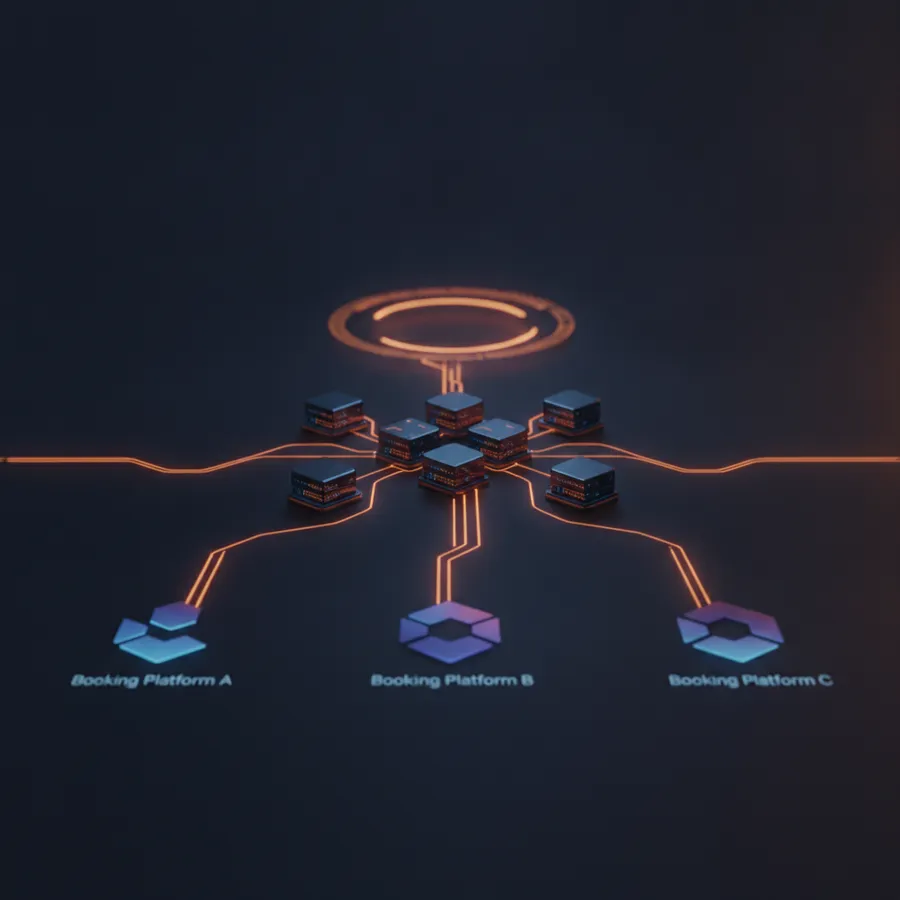
Behind any multi-platform integration sits a database that holds the single source of truth. This schema must map bookings across platforms while maintaining referential integrity.
A minimal but functional schema includes:
unknown nodeThe foreign keys between booking IDs are crucial. When a booking is created on Airbnb, your system records the airbnbreservationid. When you push availability back to Airbnb, you reference that ID. When Stripe confirms payment, you link the stripechargeid to the booking record so future reconciliation is automatic.
A second critical table tracks synchronization events:
unknown nodeThis log enables debugging. If a guest reports that their payment went through but their booking confirmation never arrived, you trace the sync log to see exactly which step failed. Did Stripe webhook fire? Did the booking record get created? Did the Lodgify availability sync actually execute? The log answers these questions in seconds.
Handling Edge Cases: What Goes Wrong in Production
Theory meets reality when the first unusual case occurs. Here are the scenarios that bite if you don't plan for them:
Overbooking race conditions: Two bookings arrive simultaneously on different platforms before either has synced availability. Both pass validation because the blocking hasn't propagated yet. Mitigation: implement a reservation lock on the database level. When a booking is created, immediately insert a blocking record with a timestamp. Other simultaneous requests check for locks before confirming. This adds milliseconds but prevents overbooking.
Partial payment failures: Stripe confirms a charge, but the webhook delivery fails due to a network glitch. Your system never receives the confirmation, so availability never gets blocked. The guest is booked and paid, but your property remains marked as available. Mitigation: build a reconciliation job that runs hourly. Query Stripe for charges created in the past 24 hours, match them to booking records in your database, and flag any missing sync entries. This catches dropped webhooks and allows you to repair them.
Cancellation cascades: Guest cancels on Airbnb, but the cancellation webhook doesn't fire, or it fires after you've already synced that booking to Lodgify as confirmed. Now you have conflicting cancellation states across platforms. Mitigation: implement idempotent cancellation. When a cancellation request arrives, check the current state before processing. If the booking is already marked as cancelled, return success without re-processing. When syncing cancellations to other platforms, include a timestamp so receiving systems can reject out-of-order updates.
Currency and amount mismatches: Airbnb charges in EUR, Stripe processes in USD, Lodgify stores in GBP. Total_amount field in your booking doesn't match what Stripe charged, causing reconciliation failures. Mitigation: store both the local amount and the charged amount, plus the conversion rate used. When reconciling, compare the charged amount to the local amount multiplied by the rate, allowing for small rounding differences.
Timezone chaos: Guest checks in "tomorrow" but tomorrow is defined differently depending on property timezone vs. platform timezone vs. server timezone. Bookings shift by a day. Mitigation: always store dates in UTC and convert to property timezone only for display. Store the property timezone as a fixed value in your properties table so conversions are consistent.
Practical Implementation: Where to Start
If you're building this integration from scratch, begin with Lodgify as your hub. Lodgify's API is the most developer-friendly of the three, and treating it as the source of truth simplifies the architecture.
Step one: Pull all existing bookings from Lodgify and create unified booking records in your database. This is a one-time data migration, not a continuous sync. Run it once, verify the data, then move on.
Step two: Set up Lodgify webhooks to listen for new bookings and modifications. When a webhook arrives, create or update the booking record and immediately push availability to Airbnb's calendar API. Test with fake bookings first.
Step three: Integrate Stripe. When a new booking is confirmed in Lodgify, generate a Stripe payment intent with the booking ID in metadata. Display the payment link to the guest. When the Stripe webhook confirms payment, mark the booking as paid and finalize availability across all systems.
Step four: Add Airbnb reads. Pull bookings from Airbnb's API on a 2-hour schedule as a fallback. If an Airbnb booking somehow arrives without triggering a webhook, the scheduled pull will catch it. Mark these bookings with sourceplatform="airbnb" and link the airbnbreservation_id.
Don't try to build bidirectional sync to Airbnb's calendar from day one. Airbnb's API restrictions make this difficult, and most hosts find that one-way sync (pushing availability from Lodgify to Airbnb) is sufficient. If Airbnb's demand is higher, you manage that through Lodgify's pricing rules, not through constant API calls.
This phased approach gets you operational in weeks, not months. You can enhance it later—add pull-based Airbnb booking reconciliation, implement automated pricing adjustments, build predictive overbooking alerts. The foundation is the webhook-based event loop connecting bookings, payments, and availability.
Further reading
For the prevention side, see Preventing double bookings, and for payments read Stripe integration for SMBs.
Frequently Asked Questions
Does Lodgify support direct Stripe integration?▾
Lodgify connects to Stripe natively for payment processing, enabling automatic charge capture at booking confirmation.
How do I prevent double bookings between Airbnb and Lodgify?▾
Use real-time channel manager synchronization via API or third-party automation tools that push availability updates every 15-30 minutes.
What technical skills are required for setup?▾
Basic API authentication knowledge helps, but no-code platforms like Zapier eliminate coding requirements for most integrations.
How long does real-time sync take between platforms?▾
Direct API connections achieve sync within 1-5 minutes; webhook-based solutions process changes within seconds.
Can I refund payments through this integration?▾
Yes, Stripe handles refunds automatically when triggered through Lodgify's dashboard or API endpoints.
Related service
Buchungssystem-Synchronisation
New articles delivered straight to your inbox
- ✓New articles delivered to your inbox
- ✓Digital marketing tips for SMEs
- ✓No spam, unsubscribe anytime
More articles

Why Barbershops & Hair Salons Need Websites That Convert—Not Just Look Pretty
Most salon websites prioritize photos over function. We reveal why conversion-driven design matters more than Instagram aesthetics—and how to build one.

Custom Weclapp Integration vs. Standard Software: ROI Analysis for SMBs in 2026
Standard ERP connectors solve 80% of use cases. This guide shows DACH SMBs when custom Weclapp integration delivers measurable ROI versus hidden costs.