
Prototype or MVP? How Startups Should Begin
A prototype shows how your product should work and tests whether customers understand the idea. An MVP is a first real version and tests whether anyone pays for it. A proof of concept checks whether the technology is feasible. Choose the stage that answers your biggest question at the lowest cost.
Many founders start with a long list: the app should have profiles, chat, payment, reviews, notifications and a dashboard. Then the first quote arrives, and the budget does not even cover half of it. The problem is rarely the price. The problem is the question everything started with.
This article helps you decide whether you need a prototype, an MVP or a proof of concept right now, what investors and funding bodies want to see at each stage and how to move from one to the next without paying twice.
The wrong question: "What should the app be able to do?"
The better question is: "What does the next version need to prove?" Each stage of product development answers a different uncertainty. If you choose the wrong stage, you spend money on answers you do not need yet and miss the answer that matters.
Typical open questions in the early phase are:
- Do my target customers immediately understand what the product does for them?
- Do they actually use it, and do they pay for it?
- Is the technology my idea is based on feasible at all?
Each of these questions has its own suitable tool.
Prototype: show the idea and get it understood
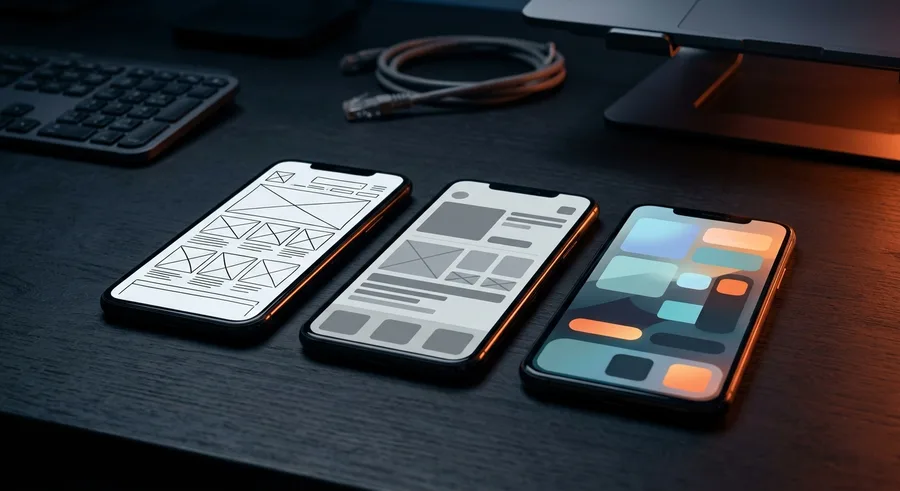
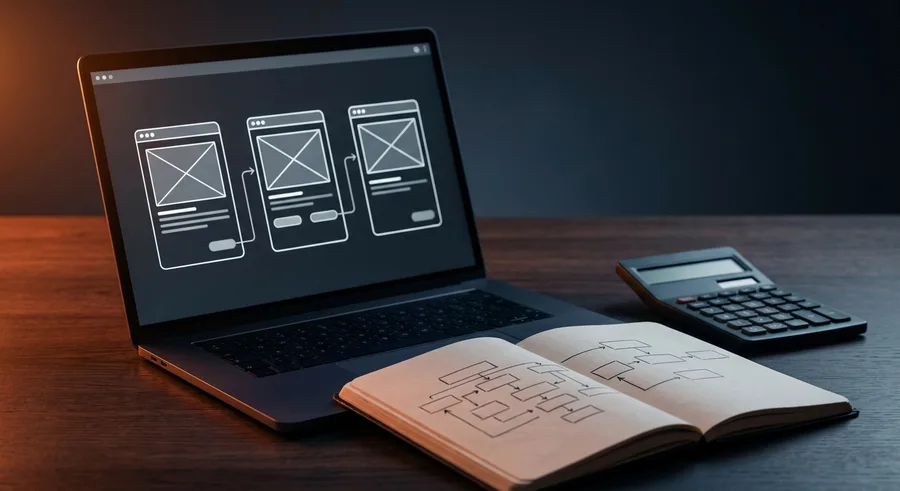
A prototype is a model of your product that shows how it should look and be used. Usually it is a clickable design: you can tap through the screens, but nothing real happens in the background. No data is stored and no payments are triggered.
A prototype is the right choice when you want to test whether customers understand the idea and find the flow logical. You sit five potential customers in front of it, let them complete a task and watch where they get stuck. That is affordable, quick and often delivers surprising insights.
What a prototype does not answer: whether anyone would pay for it. Polite test users like to say "I would use that". Whether they actually do only shows with a real version.
MVP: who really pays?
An MVP (minimum viable product) is the smallest real version of your product. Real users sign up, enter real data and ideally pay real money. The goal is not to have every feature, but to make the one core feature good enough that customers use it regularly.
An MVP is the right stage when
- customers already understand the idea, for example from conversations or prototype tests,
- you want to measure willingness to pay and actual usage,
- first pilot customers are ready or a funding application requires a working solution.
Example: a founding team wants to make job scheduling easier for trades businesses. The prototype has shown that business owners understand the flow. The MVP can now do one thing: assign jobs to employees and send the schedule to their phones. Invoicing, time tracking and material lists come later, once three pilot businesses have confirmed the basic model.
Proof of concept: when the technology itself is the uncertainty
Sometimes the big question is not the market but the technology. Can an AI reliably detect damage from photos? Can a particular machine be read out at all? Does a third-party interface deliver the data you need?
A proof of concept answers exactly that, and only that. It often has no user interface and is not meant for customers. It shows internally whether the technical core works before you build a product on top of it.
If your idea relies on uncertain technology, the proof of concept is the first stage, even before the prototype. Otherwise you can skip it.
Decision guide: three questions, one stage
If you are unsure, answer these three questions in order. The first question you answer with "no" or "I don't know" shows you the right stage.
- Is the technology your idea relies on proven? If not: start with a proof of concept. It clarifies whether the technical core works.
- Do your target customers understand what the product does for them without explanation? If not, or if unclear: build a clickable prototype and test it with five to ten people from your target group.
- Have customers already paid for it or firmly committed to it? If not: now an MVP makes sense, one that measures exactly this willingness to pay.
If you can answer all three questions with "yes", you are already at the stage of expanding the product. Then it is about growth, automation and stability.
Typical mistakes in the early phase
Regardless of the stage, these mistakes cost founders the most time and money:
- Too many target groups at once. A product for "all self-employed people" is hard to test. A clearly defined group delivers clear answers faster.
- Testing only with friends. Friends are friendly. Real feedback comes from people who have the problem every day and do not know you personally.
- Planning features instead of outcomes. "We need a chat" is a feature. "Customers should be able to clear up questions without calling" is an outcome for which there may be a simpler solution.
- No success metric. Decide in advance how you will recognise success, for example "ten businesses use the MVP every week for four weeks".
Which stage investors and funding bodies want to see
There is no fixed rule, but there is a rough orientation:
- First conversations with business angels: a clickable prototype makes the idea tangible. Team, market and first customer conversations usually matter more.
- Funding rounds: here, proof of real usage often counts, meaning an MVP with first users, revenue or letters of intent from pilot customers.
- Funding bodies: many programmes fund development projects, not the idea alone. The Basisprogramm of the FFG (Austrian Research Promotion Agency), for example, funds research and development projects by startups with up to 70 percent of project costs. According to the FFG, it is advisable to have a prototype ready when you apply; projects still in the pure idea phase are usually not eligible (as of October 2026).
For public funding you almost always apply before the project starts. Our page on AI and digitalisation funding gives an overview. The decision always lies with the funding body.
From prototype to MVP without paying twice
Many founders' biggest worry: "If I build a prototype first, will I pay for everything twice?" Not if you plan it properly.
- Design and flows are kept. The work on the prototype, meaning screens, paths through the app and texts, becomes the template for the MVP.
- Insights save development time. Every feature that fails in the prototype test does not need to be programmed.
- Reusable code is possible. If the prototype is already built with the technology the MVP will use, parts can be carried over. That costs a little more at first but saves money later.
Talk to your development partner from the start about which parts should be reused. That way the prototype does not become a throwaway product.
What this costs at EA Digital Solutions
Smaller tools and clickable prototypes start from €6,500 with us. An MVP for startups typically costs between €8,000 and €25,000, depending on user roles, payments and integrations (as of October 2026). You talk directly to the developer who builds your product, and the source code belongs to your company.
Read how we take founders from the first sketch to a paying version on our page software development for startups in Graz. More on technology and process can be found under custom software development.
Your next step
In a free initial consultation we work out together which stage your idea needs now: proof of concept, prototype or MVP. You tell us your biggest open question, and we tell you honestly how to answer it at the lowest cost. If you already have sketches, notes from customer conversations or a quote from another provider, feel free to bring them along. Our office is in Graz, and remote collaboration works just as well.
Frequently Asked Questions
How long does a clickable prototype take?▾
It depends on the number of screens and flows. A prototype of the core feature can usually be built within a few weeks, because no real technology needs to run in the background. Also plan time for tests with five to ten potential customers, because these conversations are what make the prototype valuable.
Can I turn the prototype directly into the MVP?▾
Partly. Design, flows and texts from the prototype become the template for the MVP. A clickable design has no real technology behind it, though. If the prototype is already built with the technology of the later MVP, parts of the code can also be carried over. Clarify this before the project starts.
Is a prototype enough for an investor meeting?▾
For first conversations it often is, because it makes the idea tangible. At this stage business angels usually focus more on team, market and customer conversations. For larger funding rounds, proof of real usage is often expected, meaning an MVP with first users, revenue or firm commitments from pilot customers.
Does the FFG fund prototypes?▾
The FFG Basisprogramm (Austrian Research Promotion Agency) funds research and development projects, for startups with up to 70 percent of project costs. According to the FFG, you should already have a prototype when you apply; pure ideas are usually not eligible. Whether your further development qualifies is decided by the FFG (as of October 2026).
What does a prototype cost at EA Digital Solutions?▾
At EA Digital Solutions, smaller tools and clickable prototypes start from €6,500. An MVP for startups typically costs between €8,000 and €25,000, depending on roles, payments and integrations. In a free initial consultation we work out which stage your idea really needs now and define the scope.
15 minutes
Want to know what this looks like for your company?
Pick a slot and we go through your situation together — no preparation needed, no sales pitch.
Related service
Custom Web Development
Software that fits your processes — not the other way round.
New articles delivered straight to your inbox
- ✓New articles delivered to your inbox
- ✓Digital marketing tips for SMEs
- ✓No spam, unsubscribe anytime
More articles
Prototype or MVP? How Startups Should Begin
Prototype, MVP or proof of concept: which stage your idea needs now, what investors and funding bodies want to see and how to avoid paying twice.

Building Software Without a Technical Co-Founder
No technical co-founder on the team? How to have software developed externally without becoming dependent: accounts, rights, interim versions and a clean handover.
What Does an MVP Cost? An Honest 2026 Price Guide
Why quotes for the same app idea range from €9,000 to €60,000, which five factors drive the price and how to spend your MVP budget where it counts.