

AI Agents for Business: What They Can and Cannot Do
AI agents take over recurring tasks made of reading, classifying and passing on information, such as preparing enquiries or moving data between programs. They work with narrow permissions, logging and human approval. Final decisions with legal or financial consequences stay with people.
Everyone is talking about AI agents. Vendors promise digital employees that write quotes, book appointments and look after customers on their own. Inside most companies, things look different: a few people use ChatGPT for texts, but the actual work still runs through email, Excel and a lot of copying between programs. So the question is not whether AI agents sound impressive, but where they genuinely take work off your team and where they bring more risk than benefit.
This article explains in plain language what an AI agent is, which tasks it suits, where its limits are and how to introduce a first agent safely.
What an AI agent is and how it differs from a chatbot
A chatbot answers questions. You type something in, it types something back. What happens with the answer is up to you.
An AI agent goes one step further. It receives a goal, such as "classify this enquiry and prepare a reply", and may use tools to reach it: look something up in your CRM, check a calendar, search a document or write a draft into a system. Technically, an agent has three parts:
- a language model that understands text and plans the next step
- tools, meaning access to your programs through their interfaces
- rules that define what the agent may do, what it may not do and when a person decides
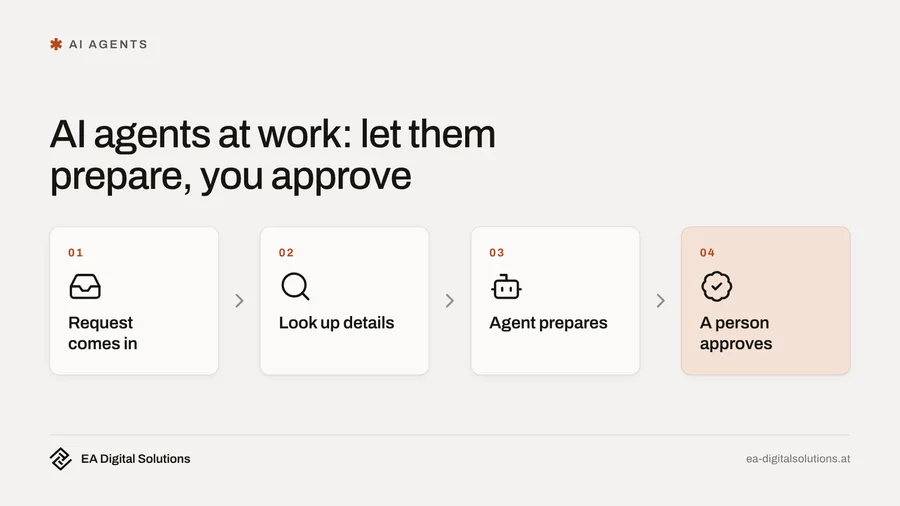
The third part matters most. An agent without clear limits is not progress, it is a risk. Good business agents are therefore rarely fully autonomous. They do the groundwork, and a person approves the result.
Where AI agents help businesses today
Agents pay off where recurring tasks consist of reading, classifying and passing on information that is already digital. Typical uses in SMEs:
- Sorting and preparing enquiries: The agent reads incoming emails or form submissions, recognises the request, looks up the relevant information and creates a draft reply. Our article on an AI agent for customer emails shows this in detail.
- Moving data between systems: Details from an order, a delivery note or an enquiry are recognised and entered into the right program, for example the CRM or the ERP.
- Checking documents: The agent compares a quote with an order or checks whether a form is missing required details, and flags any discrepancies.
- Answering internal questions: Staff ask about processes, prices or templates, and the agent answers from your own documents with a source reference. More on this in our article on an AI assistant for company knowledge.
- Preparing reports: Figures from several sources are collected and condensed into a short summary that a person reviews.
Example: A wholesaler receives orders by email every day, some as PDFs, some as plain text. An agent reads each order, matches item numbers against the inventory system and creates a draft sales order. It marks unclear lines. An employee reviews and approves the drafts instead of typing every order by hand.
45 minutes, free of charge
Want to know what this looks like for your company?
Pick a slot and we go through your situation together — no preparation needed, no sales pitch.
Where AI agents do not belong
It is just as important to know where an agent is out of place:
- Final decisions with legal or financial consequences, such as terminations, credit decisions or payment approvals. Language models can be wrong even when the answer sounds convincing.
- Tasks without clear rules. If not even your staff can say when something is right, an agent cannot either.
- Rare special cases. An agent pays off for tasks that come up often. For the one complicated case per quarter, a person is faster.
- Processes that already work with simple automation. If a fixed rule is enough, such as "invoices over 500 euros go to management", you do not need AI. A classic workflow automation is cheaper and more reliable.
A good rule of thumb: AI where language has to be understood, fixed rules where the decision is clear-cut.
Control, data protection and the EU AI Act
An agent accesses your data and programs. That is why a few points belong in the plan from day one:
- Permissions as narrow as possible: The agent only gets the access it needs for its task. Reading is different from writing, and writing is different from deleting or sending.
- Human approval: Anything that goes outside the company or moves money is checked by a person first. Only once a process has run reliably for a while can individual steps be released.
- Traceability: Every action the agent takes is logged, so you can see what it did and why.
- Data protection: If personal data is processed, you need a data processing agreement with the AI provider and should know where the data is processed. For decisions that significantly affect people, the GDPR (Art. 22) restricts purely automated decisions. Another reason for human approval.
- EU AI Act: Since 2 February 2025, companies that use AI professionally must promote the AI literacy of their staff (Art. 4). Since 2 August 2026, transparency duties under Art. 50 apply: if an AI system talks directly to people, for example as a chat on your website, you generally have to tell them that they are dealing with AI. You will find an overview on our EU AI Act page.
This section reflects the situation as of October 2026 and is not legal advice.
How to introduce your first AI agent
The safest route is a small, clearly defined start rather than a big plan for the whole company.
- Pick one task: Choose a recurring activity that takes a lot of time and has clear rules. Enquiries, orders or receipts are good candidates.
- Write down today's process: Who does what, with which programs, and how do you recognise a good result? Collect real examples, including difficult ones.
- Build the agent with approval: The agent prepares, a person checks and approves. The connection to your programs runs through their interfaces, not through workarounds.
- Test with real cases: For a few weeks, the agent runs alongside the existing process. You compare the results and adjust the rules.
- Only then expand: Once the quality is right, more tasks are added or individual approvals are dropped.
Do not only measure the time saved, but also the error rate and how often staff have to change the draft. These figures show honestly whether the agent helps.
What an AI agent costs
The cost has two parts: the one-off development and integration, and the running costs for the language model, hosting and support. Running costs depend heavily on how many cases the agent processes and which model it uses.
At EA Digital Solutions, AI integration starts at 2,500 euros and connecting existing programs through system integration starts at 4,500 euros (as of October 2026). If you first want to know which tasks are suitable at all, start with an AI potential analysis for 890 euros. We quote the exact price after the initial consultation, once it is clear what the agent should do.
Common misconceptions
- "An agent replaces an employee." In practice it takes over parts of a job, usually the repetitive groundwork. Responsibility stays with people.
- "The more autonomous, the better." For businesses, the opposite tends to be true: the narrower the task and the clearer the approvals, the more reliable the result.
- "We need a big AI strategy first." A strategy helps, but a first agent for one concrete task shows faster what works in your business.
Your next step
In a free initial consultation we look at which task in your company suits a first AI agent and which programs need to be connected. Feel free to bring two or three typical examples, such as forwarded emails or receipts. You talk directly to the developer who will later build the agent. Our office is in Graz, and working together remotely works just as well.
Frequently Asked Questions
What is the difference between an AI agent and a chatbot?▾
A chatbot answers questions, and you decide what happens next. An AI agent receives a goal and may use tools to reach it, such as checking the CRM, searching documents or writing drafts into a program. That is why an agent needs clear rules about which actions it may take and when a person approves.
Which tasks suit an AI agent in an SME?▾
Recurring work where text is read, classified and passed on: preparing enquiries, capturing orders, checking documents or answering internal questions from company documents. The information has to be available digitally, and it must be clear what a good result looks like. Rare special cases are better left to people.
May an AI agent send emails on its own?▾
Technically yes, but it is not advisable at the start. Anything that leaves the company or moves money should first be checked by a person. Only once a process has run reliably for a while and the error rate is known can individual, clearly defined steps run without approval. Every action is logged.
What do I need to consider under the EU AI Act?▾
Since 2 February 2025, companies that use AI professionally must promote the AI literacy of their staff. Since 2 August 2026, Art. 50 generally requires that people are told when an AI system talks to them directly. This reflects the situation as of October 2026 and is not legal advice.
What does an AI agent cost for my company?▾
There are one-off costs for development and integration and running costs for the language model, hosting and support. At EA Digital Solutions, AI integration starts at 2,500 euros and connecting existing programs starts at 4,500 euros (as of October 2026). We quote the exact price after a free initial consultation.
45 minutes, free of charge
Want to know what this looks like for your company?
Pick a slot and we go through your situation together — no preparation needed, no sales pitch.
Related service
AI Integration & Automation
Intelligent processes that run on their own — OpenAI, Claude, n8n and custom models integrated seamlessly into your workflow.
New articles delivered straight to your inbox
- ✓New articles delivered to your inbox
- ✓Digital marketing tips for SMEs
- ✓No spam, unsubscribe anytime
More articles
AI Agents for Business: What They Can and Cannot Do
What an AI agent is, which tasks it can take over in SMEs, where it is out of place and how to start safely with one clearly defined task.

Automating Incoming Invoices: How It Works
How to read, check, approve and pass incoming invoices to accounting or your ERP automatically, and where a person should still review them.

AI Agents for Customer Emails: The Dos and Don'ts
How an AI agent reads recurring email enquiries, prepares replies and connects to your shop or CRM, and what the GDPR and the EU AI Act require along the way.