

Digitalisation for SMEs: Where to Start? 4 Steps
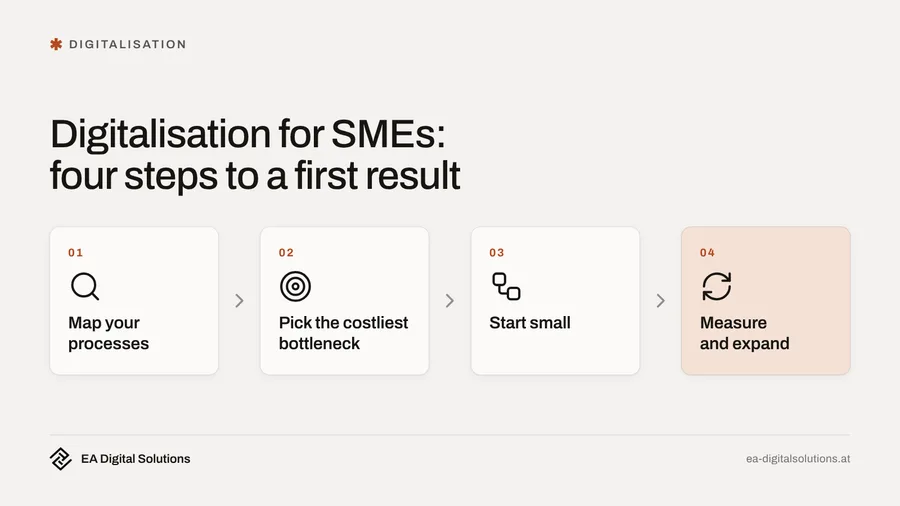
Don't start with software, start with your processes: write down two or three central processes, pick the most frequent and costly bottleneck, solve it on a small scale with the programs you already have and measure the result. Only then take the next step.
Everyone talks about digitalisation, but day-to-day work in the business looks different: quotes are written in Word, orders sit in an Excel list, invoices are typed in by hand, and anyone who wants to know how far an order has got phones the office. At the same time, offers for new software, apps and AI tools arrive every day. Many managing directors of small and medium-sized businesses don't know where to start, so the topic keeps getting postponed.
This article shows a simple way in four steps: from mapping your processes and choosing the first project to expanding. No jargon, no big-bang project, and a result you can feel within a few weeks.
Why many digitalisation projects get stuck
Before looking at the right start, it is worth looking at the typical reasons why projects fail or never begin:
- Starting with the tool instead of the problem: new software is bought because it sounds good. Afterwards it turns out that it doesn't solve the real bottleneck.
- Wanting everything at once: a new ERP, a new CRM and a new website in the same year overwhelm any small team.
- Not bringing the team along: the people who work with a process every day know best where it sticks. Without them you get a solution nobody uses.
- No measurable goal: if nobody knows what should improve, nobody can say whether it worked.
The good news: all four can be avoided with a step-by-step approach.
Step 1: Map your processes, don't shop for software
The start is not a product selection but an honest look at the work. Pick two or three central processes, for example from enquiry to quote, from order to invoice or from goods receipt to booking. For each process, ask:
- Who does what, in which order?
- Where is data typed in or copied? Every duplicate entry is a candidate.
- Where do people wait? For an approval, a reply, a piece of information.
- Where do mistakes happen? Wrong prices, forgotten line items, lost emails.
- Which programs are involved? Often more than you think: email, Excel, accounting, calendar, online shop.
Ideally do this together with the employees who handle the process every day. A whiteboard or a sheet of paper is completely enough. What matters is writing down the actual process, not the one in the handbook.
Step 2: Tackle the costliest bottleneck first
After mapping, you usually have a long list. Not everything is equally important. Rate each point with three simple questions:
- How often does it happen? Daily matters more than once a quarter.
- How much time does it cost? Roughly estimate the hours per month.
- What does a mistake cost? A wrong invoice or a lost enquiry can cost more than many hours of manual work.
For the start, choose a process that happens often, costs noticeable time and can be clearly separated from the rest. That is your first project. Everything else goes on a list for later.
Example: a plumbing and heating business with twelve employees notices that supplier invoices are typed in one by one every week, compared with purchase orders and forwarded to the tax adviser. This happens dozens of times a month, costs hours and keeps causing queries. This process is a good candidate for the start. Our article Automating incoming invoices shows what that can look like in practice.
45 minutes, free of charge
Want to know what this looks like for your company?
Pick a slot and we go through your situation together — no preparation needed, no sales pitch.
Step 3: Start small, with what you already have
The first project should be measurable in weeks, not years. A simple rule helps: first use the programs you already have, and connect them better.
Many businesses already have accounting software, an email program, a calendar and perhaps an inventory system. Often what is missing is not the next program but the connection between the existing ones. Typical first steps are:
- Passing data on automatically instead of retyping it, for example enquiries from the contact form going straight into a list or the CRM
- Automating recurring tasks, such as reminders, confirmations or forwarding
- A shared filing system instead of files in personal inboxes
- A simple overview that shows where each order currently stands
Automation tools such as n8n are well suited to these connections, because they link processes across different programs without a large software project. More on our page on n8n automation. If that isn't enough, for example because your process is very specific and several Excel lists depend on each other, a small custom application can make sense. Our article Replacing Excel: when custom software pays off describes when that is the case.
Important in this phase: run the new solution in parallel with the old way until everyone involved trusts it. And write down briefly how it works, so that more than one person knows.
Step 4: Measure and expand
After a few weeks, look back: has the process become faster? Are there fewer mistakes and queries? Do employees like using the solution, or do they work around it? Measure only a few things you can see anyway, such as the time per case or the number of queries. Also ask the team directly: short conversations often show faster than any report where improvements are still needed.
If the first project works, take the next item from the list. Step by step you build a digital way of working that suits your business, instead of one big overhaul that burdens everyone at once. This often also shows where artificial intelligence can genuinely help, for example by pre-sorting emails or reading documents. AI is then one building block in an already organised process, not an end in itself.
What you don't need to get started
A few myths hold many businesses back unnecessarily:
- No large IT department: for the first steps, one responsible person in the business and an external partner who listens are enough.
- No finished digital strategy: a short list of goals and priorities is enough at the start. The strategy grows from the first results.
- No complete replacement of your software: proven programs often stay in use and are simply connected better.
- No big budget to start: a clearly defined first project costs a fraction of a major system change.
Funding: check before the project starts
In Austria there is funding for digitalisation projects, for example through aws. aws Digitalisierung awards non-repayable grants of up to 150,000 euros depending on the programme. Calls open and close, however, and in October 2026 no AI call of aws Digitalisierung was open according to aws.at. In Styria, SFG also supports businesses; you can find its current programmes on sfg.at. Important in almost all cases: the application must be submitted before the project starts (as of October 2026). Our article aws grants for digitalisation and AI gives an overview of the aws programmes, and you can find more about funding for AI projects on our page AI funding in Austria.
How we support you
For the first and second step we offer the digitalisation check at a fixed price of 690 euros (as of October 2026). Together with you we map the most important processes, assess the bottlenecks and recommend a first project with a rough effort estimate. You get a clear overview, not a hundred-page study. More on our page Digital transformation in Graz.
Your next step
Not sure which process in your business is the right place to start? In a free initial consultation we listen, ask the right questions and tell you honestly whether a project is worthwhile and where you should begin. Our office is in Graz, and remote collaboration works just as well, with direct contact to the people who build your solution.
Frequently Asked Questions
Where should an SME start with digitalisation?▾
With a process, not with software. Write down with your team how, for example, an enquiry becomes a quote or an order becomes an invoice. Where data is entered twice, where people wait or where mistakes happen is usually the best starting point for your first project.
How do I find the right first project?▾
Rate each bottleneck with three questions: how often does it happen, how much time does it cost and what does a mistake cost? Choose a process that happens often, costs noticeable time and can be clearly separated. Everything else goes on a list for later and is reassessed after the first result.
Do I need new software to digitalise?▾
Often not. Many businesses already have accounting, email, a calendar and an inventory system, and only the connection between these programs is missing. Automation tools such as n8n can pass data on and handle recurring tasks. A custom application only pays off when a process is very specific and standard programs don't fit.
Is there funding for digitalisation in Austria?▾
Yes, for example through aws Digitalisierung with non-repayable grants of up to 150,000 euros depending on the programme. Calls open and close, and in October 2026 no AI call was open according to aws.at. In Styria, SFG also provides support. You almost always apply before the project starts (as of October 2026).
What does the digitalisation check at EA Digital Solutions cost?▾
The digitalisation check costs 690 euros at a fixed price (as of October 2026). Together with you we map the most important processes, assess the bottlenecks and recommend a first project with a rough effort estimate. You receive a clear overview instead of a long study. The initial consultation beforehand is free.
45 minutes, free of charge
Want to know what this looks like for your company?
Pick a slot and we go through your situation together — no preparation needed, no sales pitch.
Related service
n8n Workflow Automation
Complex processes automated — self-hosted, no subscription trap.
New articles delivered straight to your inbox
- ✓New articles delivered to your inbox
- ✓Digital marketing tips for SMEs
- ✓No spam, unsubscribe anytime
More articles
Digitalisation for SMEs: Where to Start? 4 Steps
Where a small or medium-sized business should start with digitalisation: four steps from mapping processes to a first measurable result, without a new large system.

Choosing an IT Service Provider in Graz: 8 Questions
How companies and startups in Graz find the right IT service provider for software, integrations and digitalisation, with eight questions for the first meeting.

Replacing Excel: When Custom Software Pays Off
When shared Excel files become a risk, what should stay in Excel and how to move step by step to software that fits your processes.