

Building a SaaS MVP: Planning Subscriptions and Payment
A SaaS MVP needs company accounts with roles, one core feature, a subscription with payment, a customer portal and correct invoices. A provider like Stripe handles payment, dunning and the portal. At EA Digital Solutions an MVP usually costs 8,000 to 25,000 euros, SaaS towards the upper end.
The idea is there: software your customers pay for every month. The first prospects have said they would try it. But as soon as you start planning the build, questions come up that have little to do with the idea itself: How do several employees of one customer log in? What happens when a credit card expires? Who writes the invoices, and with which VAT? At this point many founders realise that a subscription product is more than a few screens behind a login.
This article shows what a SaaS MVP really needs, what you can safely postpone and how to plan subscription, payment and invoicing from the start so you don't have to rebuild after three months.
How a SaaS MVP differs from a simple MVP
SaaS stands for software as a service: your customers install nothing, they use the software in the browser and pay for it regularly. An MVP is the first version that real customers work with and pay for. If the difference to a clickable prototype isn't clear yet, read our article Prototype or MVP? first.
A subscription product adds three things that a one-off application doesn't have:
- Many customers in one system: each customer only sees their own data, even though everyone uses the same software. Developers call this multi-tenancy.
- Recurring payment: the software has to know who has paid, who is in a trial and who should be locked out.
- Self-service: customers want to change payment details, download invoices or cancel without emailing you.
These three points are not a luxury. They decide whether your MVP runs without daily manual work.
Accounts, teams and roles: the foundation
The most important decision comes right at the start: does a subscription belong to a person or to a company? For software sold to businesses, the answer is almost always the company. You then need a company account under which several people work, and at least two roles: someone who manages the subscription and people who only use the software.
For an MVP this is usually enough:
- Sign-up and login with email and password or a login link
- Inviting colleagues into their own company account
- Two roles, for example administrator and member
- Clean separation of data between company accounts
What you can postpone: complex permission schemes with many levels, login through the corporate directory of large customers and several company accounts per person. What matters is that the data structure is set up so these features can be added later without rebuilding everything.
45 minutes, free of charge
Want to know what this looks like for your company?
Pick a slot and we go through your situation together — no preparation needed, no sales pitch.
Subscription and payment: what Stripe takes care of
Programming recurring payments yourself is practically never worth it for an MVP. Payment providers like Stripe bring the building blocks. According to the Stripe Billing documentation, Stripe automatically creates invoices for a subscription, attempts to collect payment and manages the subscription status throughout its lifecycle. Trials, retries for failed payments and dunning are part of it too.
There is also a ready-made customer portal: your customers can update payment methods and billing details, change or cancel subscriptions and view and download current and past invoices. For an MVP this means you don't have to build these screens yourself.
Your own software still has to know a few things and react correctly:
- When someone gets access: only after a successful payment or already during the trial
- What happens when a payment fails: show a notice, give a grace period, then restrict access
- Which plan unlocks which features, if you offer several packages
- What happens to the data when someone cancels
You define these rules, not the payment provider. Technically they are implemented through notifications that Stripe sends to your software whenever something changes in a subscription. You can find more about the connection on our page on Stripe integration.
Pricing model: start simple, refine later
Many founders spend weeks on pricing tiers before the first customer has paid. For an MVP a simple model is usually better: one or two plans, monthly or annual, perhaps with a trial. Usage-based billing, for example per number of transactions, is possible but makes the first version considerably more complex, because your software has to count and report usage reliably.
Example: a startup builds scheduling software for cleaning companies. Instead of six pricing tiers it starts with one plan per company account and a surcharge above a certain number of users. After the first paying customers it becomes clear which feature really makes the difference. Only then is a second plan introduced.
Don't forget invoices and VAT
As soon as you sell, you need correct invoices. For software provided over the internet, VAT depends on who your customer is and where they are based:
- Business customers in other EU countries with a valid VAT ID: the tax liability usually passes to the recipient. The VAT ID has to be recorded and checked.
- Private customers in other EU countries: for electronically supplied services there is an EU-wide threshold of 10,000 euros per year. Above it, the VAT of your customer's country generally applies, reported collectively through the One-Stop-Shop (OSS).
- Customers in Austria: Austrian VAT applies.
With Stripe Tax, Stripe offers automatic tax calculation that also works for subscriptions. Whether that is enough for your model and how the data reaches your accounting is something to clarify with your tax adviser. Software implements their requirements, it does not replace tax advice. Our article Connecting Shopify with BMD shows how the handover to accounting can work, using an online shop as the example.
Data protection and contracts from the start
When business customers process personal data in your software, such as employee names or customer contacts, you process that data on their behalf. The GDPR requires a data processing agreement for this (Art. 28 GDPR). Larger customers will also ask where the data is stored and which service providers you use.
For an MVP this means:
- choose hosting and database in the EU where possible
- keep a list of the service providers you use, for example for hosting, email delivery and payment
- have terms of use, privacy policy and data processing agreement ready before the first paying customer, ideally with legal support
It sounds like bureaucracy, but it saves time: a business customer who gets these documents straight away signs faster.
What belongs in the first version and what doesn't
A simple split helps keep the scope small:
Must: login, company account with invitations, two roles, the one core feature customers pay for, subscription with payment and customer portal, correct invoices, a simple area for you to see customers and subscriptions.
Later: several plans with many tiers, usage-based billing, connections to your customers' systems, detailed reports, separate apps for iOS and Android.
Never without a reason: features that only one single prospect asked for.
The clearer the must list, the more predictable the price. Our article What does an MVP cost? explains in detail which points drive the cost.
What to expect
At EA Digital Solutions, an MVP for startups typically costs 8,000 to 25,000 euros. Smaller tools and prototypes start from 6,500 euros, extensive web apps from 15,000 euros (as of October 2026). Because of company accounts, roles and subscription logic, a SaaS MVP usually sits in the upper part of this range. Further connections, for example to a CRM or accounting, are charged as system integration from 4,500 euros.
All accounts, meaning hosting, domain, Stripe and the code repository, are registered to your startup. That way you can build your own team later or switch provider without starting from scratch. More on our page Software development for startups in Graz and under Custom software.
Your next step
In a free initial consultation we go through your idea together: who are your paying customers, which core feature must the first version have and which pricing model fits the start? Afterwards you receive a scope proposal and a fixed price. Our office is in Graz, and remote collaboration works just as well, with direct contact to the developer.
Frequently Asked Questions
Do I need to have subscription payments programmed from scratch?▾
No. Payment providers like Stripe automatically create invoices for subscriptions, collect payments, retry failed attempts and offer a customer portal. Your software only needs to know when someone gets access, what happens after a failed payment and which plan unlocks which features. You define these rules together with your developer.
What does multi-tenancy mean for SaaS software?▾
Multi-tenancy means that many customers use the same software, but each only sees their own data. For business software the subscription usually belongs to a company with several employees working under it. This separation has to be built into the data structure from the start, because changing it later is far more expensive.
Which pricing model is best for the start?▾
For an MVP one or two plans are usually enough, monthly or annual, perhaps with a trial. Usage-based billing is possible but makes the first version more complex, because usage has to be counted reliably. Refine your pricing only once paying customers show you which feature really matters to them.
Which VAT applies to SaaS sold to customers in the EU?▾
For business customers with a valid VAT ID the tax liability usually passes to the recipient. For private customers in other EU countries, the VAT of the customer's country generally applies above an EU-wide threshold of 10,000 euros per year, reported through the One-Stop-Shop. Always check your model with your tax adviser.
What does a SaaS MVP cost at EA Digital Solutions?▾
An MVP for startups typically costs 8,000 to 25,000 euros with us, and a SaaS MVP usually sits at the upper end because of company accounts, roles and subscription logic. Further connections to a CRM or accounting start from 4,500 euros (as of October 2026). After the free initial consultation you receive a fixed price for the agreed scope.
45 minutes, free of charge
Want to know what this looks like for your company?
Pick a slot and we go through your situation together — no preparation needed, no sales pitch.
Related service
Custom Software Development
Software for your processes, fixed price from €6,500.
New articles delivered straight to your inbox
- ✓New articles delivered to your inbox
- ✓Digital marketing tips for SMEs
- ✓No spam, unsubscribe anytime
More articles
Building a SaaS MVP: Planning Subscriptions and Payment
A subscription product is more than a login: company accounts, recurring payment, a customer portal and correct invoices. How to plan the first version without rebuilding later.
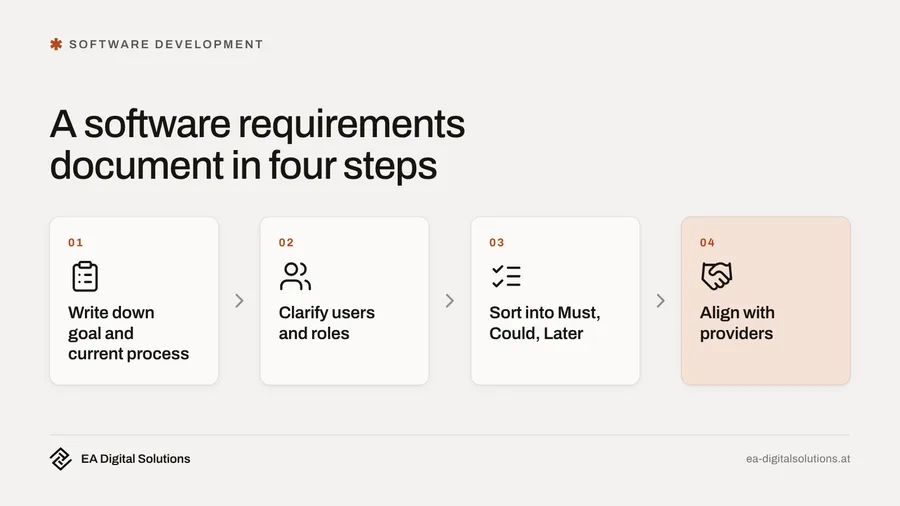
Software Requirements Document: How to Describe Your Project
Three quotes, three completely different prices? With a short requirements document, every provider works from the same basis. Here is how to write one without technical knowledge.

Prototype or MVP? How Startups Should Begin
Prototype, MVP or proof of concept: which stage your idea needs now, what investors and funding bodies want to see and how to avoid paying twice.