

FFG Basisprogramm: Funding for Startup Software 2026
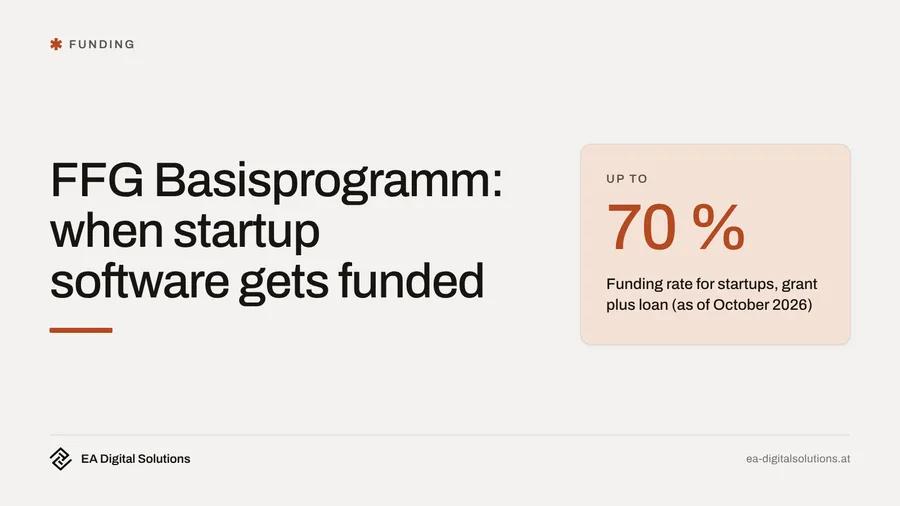
The FFG Basisprogramm funds startups with up to 70 percent of project costs as a grant plus loan, up to 3 million euros (as of October 2026). It requires real development with technical risk. A standard MVP usually does not qualify. Apply before the project starts.
The idea is clear, maybe a prototype already works, and then the money question comes up: the quote for the first real version of your software is higher than what is in the bank. Talk to other founders and the name FFG Basisprogramm comes up quickly. Up to 70 percent funding sounds tempting. What usually stays unclear is whether your project fits at all, what gets funded and when you need to apply.
This article explains what the Basisprogramm of the Austrian Research Promotion Agency (FFG) can do for startup software, where applications often fail and what alternatives exist if your project does not fit. All details reflect the situation as of October 2026. Funding conditions change, so always check the current call on ffg.at before you apply.
What the FFG Basisprogramm funds
The Basisprogramm is the FFG's main funding instrument for corporate research and development projects. Large companies, small and medium-sized enterprises and companies in the founding phase can apply. According to the FFG, it targets projects with a high degree of innovation that are technically demanding and carry a high technical risk.
The key figures of the Basisprogramm 2026 (as of October 2026, according to ffg.at):
- Funding rate: usually 50 percent of project costs, up to 70 percent for startups in the founding phase. The rate depends mainly on company size.
- Form: a combination of grant and loan, not a grant alone.
- Startups: according to the FFG, high-tech startups can receive an additional 5 percent bonus, and for startups loan repayment only starts five years after the project ends.
- Maximum: up to 3 million euros of funding per project.
- Submission: possible at any time; the 2026 call runs from 1 January to 31 December 2026.
Important for planning: you have to finance the rest of the project costs yourself, and the FFG asks for proof of how this own share is financed.
Not every MVP is a research project
This is the most common misconception. The Basisprogramm funds development where it is not clear at the start whether it will work technically. A web app with login, forms and payments may be new for your startup, but technically it is a solved problem. That is not what the programme is for.
Projects like these have better chances:
- New methods: for example your own way of analysing sensor data, or an algorithm that solves a task for which no ready-made solution exists.
- Technical risk: it is open whether the required accuracy, speed or scale can be reached.
- A clear gain in knowledge: at the end you know more than before, even if one approach fails.
Example: a startup wants to detect and classify building damage on photos automatically. The customer interface is standard technology. Whether a self-trained model recognises the damage reliably enough, on the other hand, is real development with risk. That part would be the core of an application.
The FFG also explicitly recommends that startups can show a prototype when they apply. According to the FFG, very early-stage ventures are usually not suitable, and the Basisprogramm is not general founding finance. If you are still at the pure idea stage, read our article Prototype or MVP? first.
45 minutes, free of charge
Going through your project with us
Pick a slot and we go through your situation together — no preparation needed, no sales pitch.
Which costs are recognised
Funding covers costs that can be attributed directly to the project. The Basisprogramm lists personnel costs, costs for the use of equipment, material and operating costs, travel costs and third-party costs. The FFG cost guideline adds overheads as a flat rate.
For startups that have their software developed externally, in full or in part, two points matter:
- Third-party costs are possible but can be limited: purchased services such as contract development count as third-party costs. According to the cost guideline, their recognition can be restricted in the relevant programme guidelines. So clarify with the FFG before applying what share of external services is accepted for your project.
- Only work within the funding period counts: the cost guideline requires that services are delivered within the funding period set in the funding contract. Work you have developed beforehand is not funded retroactively. Apply before the project starts, not once the invoice has arrived.
Marketing and sales costs, among others, are not recognised. The final recognised costs are only fixed after the project ends, when the FFG reviews the statement of costs. Plan a buffer and do not assume that every euro will be funded.
Smaller projects: the Basisprogramm Kleinprojekt
For smaller development projects there is the Basisprogramm Kleinprojekt, aimed at SMEs and startups. The 2026 key figures according to ffg.at (as of October 2026):
- experimental development projects with total costs of up to 150,000 euros
- funding as a grant, not a loan
- funding rate for small enterprises 45 percent, up to 60 percent with a scientific partner; for medium-sized enterprises 35 or up to 50 percent
- a maximum of 88,500 euros of funding per project
- ongoing submission, with decisions in several meetings per year
Interesting for startups: the FFG explicitly names an MVP or a proof of concept as a possible result. Here too, though, the project must be technically challenging and innovative. Projekt.Start, the small grant for preparing a development project, is already closed for 2026.
Common mistakes in applications
These stumbling blocks are typical and can be avoided with a little planning:
- Applied too late: development is already running and the application comes afterwards. Work already delivered then drops out.
- Product described instead of development: the application explains the market and the features, but not which technical problem is solved and why that is uncertain.
- Own share not secured: without proof of how you finance your share, it gets difficult. Even at 70 percent funding, 30 percent stays with you, plus costs that are not recognised.
- Cost plan without structure: if you plan external development, you need a quote that clearly separates work packages and results, so costs can be allocated in a traceable way.
- Everything on one card: the FFG makes the decision. Plan your project so that a smaller version can go ahead without funding.
What this means for your software project
At EA Digital Solutions, an MVP for startups typically costs 8,000 to 25,000 euros, and smaller tools and prototypes start from 6,500 euros (as of October 2026). For many of these projects the Basisprogramm is not the right instrument, because they use proven technology. That is not a disadvantage: a well-planned first version without a funding application often reaches the market faster.
If your project has a genuine development core, a clear split helps: what is standard, such as login, admin and payments? And where is the technical risk? You need this split for the application anyway, and it shows you which part should be built first. We support you with a traceable quote broken down by work packages. You submit the application yourself, and the FFG makes the decision.
We cover other funding routes for digitalisation and AI projects, for example from aws or SFG, on our page AI funding in Austria and in the article on aws grants. To see how we work with startups, visit software development for startups in Graz and custom software development.
How to proceed
- Define the core: write down in three sentences which technical problem your software has to solve and why the solution is not yet certain.
- Check the programme: read the current call and the cost guideline on ffg.at. The FFG also offers advice before submission.
- Plan work packages and costs: separate your own and external work, as well as standard features and the development share.
- Secure your own share: clarify how you will finance your share and any costs that are not recognised.
- Apply first, then start: only begin the funded part within the funding period.
Your next step
In a free initial consultation we look at your project and tell you openly whether it looks like a development project with a chance of funding, or whether a lean first version without an application is the better route. You then receive a quote broken down by work packages that you can use for a cost plan. Our office is in Graz, and remote collaboration works just as well.
Frequently Asked Questions
How much does the FFG Basisprogramm fund for startups?▾
According to the FFG, it usually funds 50 percent of project costs, and up to 70 percent for startups in the founding phase, with a maximum of 3 million euros per project. Funding combines a grant and a loan. High-tech startups can receive an additional bonus. The FFG sets the exact rate (as of October 2026).
Does the Basisprogramm fund every new app?▾
No. It funds research and development with a high degree of innovation and technical risk. A web app with login, forms and payments is a solved problem technically and usually does not qualify. A project has a chance when it is open whether a new method or algorithm will work as planned.
Can I outsource the software development?▾
Purchased development counts as third-party costs in the FFG cost guideline and is possible in principle. However, programme guidelines can restrict how much of it is recognised. Clarify with the FFG before applying what share of external services is accepted, and ask for a quote broken down by work packages.
Can I still apply after the project has started?▾
According to the cost guideline, only work delivered within the funding period set in the funding contract is funded. Anything developed beforehand drops out. So apply before the funded part starts. The Basisprogramm 2026 accepts applications on an ongoing basis, and the submission period ends on 31 December 2026.
Is there an option for smaller projects?▾
Yes, the Basisprogramm Kleinprojekt for SMEs and startups. It funds experimental development projects with total costs of up to 150,000 euros as a grant: 45 percent for small enterprises, up to 60 percent with a scientific partner, at most 88,500 euros. The FFG names an MVP as a possible result (as of October 2026).
45 minutes, free of charge
Going through your project with us
Pick a slot and we go through your situation together — no preparation needed, no sales pitch.
Related service
Custom Software Development
Software for your processes, fixed price from €6,500.
New articles delivered straight to your inbox
About two editions a month on software, automation and visibility for SMEs. Unsubscribe with one click.
More articles
FFG Basisprogramm: Funding for Startup Software 2026
When startup software fits the FFG Basisprogramm, which costs are recognised, what the Kleinprojekt offers and why you have to apply before the project starts.
Building a SaaS MVP: Planning Subscriptions and Payment
A subscription product is more than a login: company accounts, recurring payment, a customer portal and correct invoices. How to plan the first version without rebuilding later.
Software Requirements Document: How to Describe Your Project
Three quotes, three completely different prices? With a short requirements document, every provider works from the same basis. Here is how to write one without technical knowledge.